
Want to Get Better at Ag Sales? Understand How Your Brain Taps Into Geospatial Information
3-Minute Read Time
By Jamieson Potter, Head of Business Development and Sales, CamoAg
In the world of ag sales, data is everywhere. You have lists of prospects, spreadsheets of category sales, customer purchase histories, performance reports, and on and on. The challenge today isn’t lack of information, it’s mental overload.
How do you turn endless rows of data into actionable insight before your next farm visit?
For years, memory champions have used a secret weapon that science is now validating – the immense power of spatial visualization.
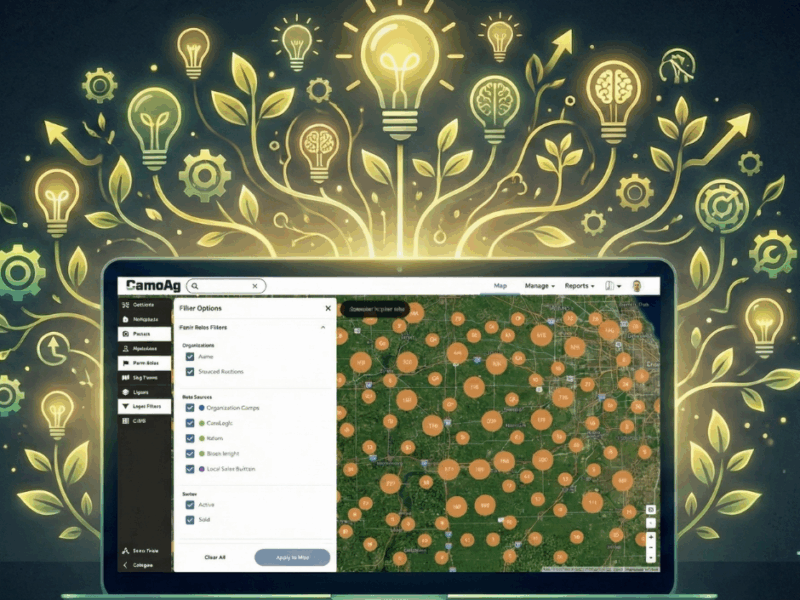
Shocker alert: It turns out that our brains are not designed to memorize spreadsheets. They are designed to navigate the physical world. This is why the CamoAg platform puts such an emphasis on sales-focused geospatial intelligence tools in addition to providing access to deep ag data. Read on to see how sales teams can hack their own biology to understand territories faster, remember customer details better, and spot opportunities that may remain hidden in ERPs and CRMs.

Tapping Into Your Brain’s Internal GPS
The biological link between location and memory is profound. In 2014, the Nobel Prize in Medicine was awarded for the discovery of “place cells” in the hippocampus, the brain’s center for memory and learning. These cells act as an internal GPS, creating a cognitive map of your surroundings.
Interestingly, the same neural hardware you use to remember where you are is used to store memories of events and factual data.
Traditional sales tools often fight against this biology by separating data from location. Geospatial tools like those in CamoAg lean into it.
Seeing farm data in its geographic context allows you to internalize the “lay of the land” far faster than reading reports. You intuitively understand which growers are impacted, for example, by the same watershed issues or which prospects are clustered near your current best customers.
Your Territory is Your “Memory Palace”
How do memory athletes – yes, that’s a thing – memorize the order of thousands of shuffled playing cards in minutes? They don’t rely on rote repetition. They use an ancient technique known as the “Method of Loci” or the “Memory Palace.”
These mental champions place each card in a specific physical location along a familiar route, like placing the Ace of Spades on their kitchen counter and the King of Hearts on their sofa. To recall the data, they simply visualize walking through their mental house and finding the cards.
Modern neuroscience has validated how this works. Research comparing top memory competitors to average people found that the champions weren’t necessarily smarter, they were just utilizing different brain networks. Specifically, the areas for spatial navigation.
As an ag sales professional, you don’t need an imaginary palace. You have a real one – your territory.
When you look at a spreadsheet of 500 producers, your brain struggles to create connections. But when you view those same 500 producers mapped using geospatial tools like those in CamoAg – showing their exact parcel boundaries relative to customers and competitors – you are feeding your brain data in its preferred format and making deeper connections.
“Dual Coding”: Seeing is Understanding
Why does adding maps with rich data to a sales report make it so much more effective? Cognitive psychologists explain this through “Dual Coding Theory.”
This theory posits that the brain has two separate processing channels: one for verbal/text information and another for non-verbal visual/spatial images. When you present information using both text (farm stats, contact names) and visuals (plat maps, satellite imagery) simultaneously, you create two separate memory traces in the brain.
This creates more mental pathways to retrieve the information later. It also helps to understand complex relationships. It’s one thing to read that five customers in a region are expanding faster than others, it’s another to see those five farms clustered together on a map, highlighting where this growth is occurring and in what situations.
The CamoAg Advantage: Sales Effectiveness Through Visualization
CamoAg serves as an external cognitive aid to sales leaders and territory reps, instantly providing the rich visuals and mapping capabilities your brain craves. It takes abstract ag data and places it in the real world.
By using CamoAg to visualize farms and producers, sales teams are doing more than just organizing data. They are:
- Reducing Cognitive Load: They avoid wasting mental energy trying to recall product placements on fields. Instead, they see it instantly in context.
- Accelerating Onboarding: New territory managers can grasp the dynamics of their area in weeks instead of months or years.
- Uncovering Hidden Patterns: Seeing the geospatial relationships between soil types, crop history and buying behaviors, for example, reveals sales opportunities that spreadsheets conceal.
Your brain wants an interactive, updated sales map. Give it one, and watch your understanding of your territory and your sales results improve